


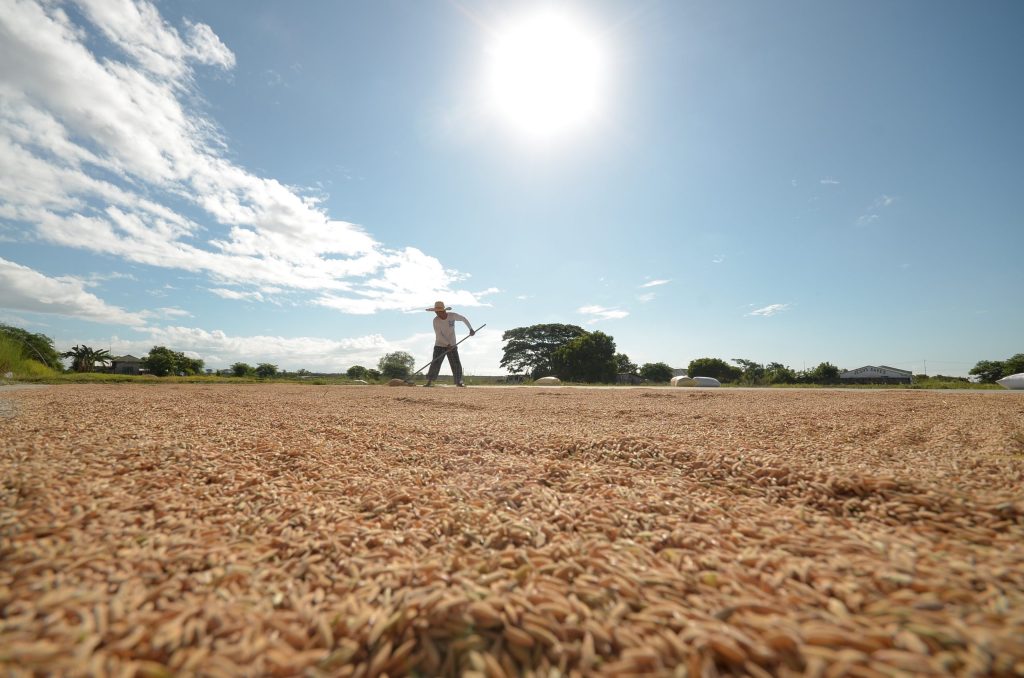
The DA has identified four key strategies to improve production, including climate change adaptation, farm clustering and consolidation, a value chain approach, and digital transformation of the Philippine rice industry.
The Philippines is seeking to achieve full rice self-sufficiency in four years, despite facing a potential crisis on its staple commodity. The country’s Department of Agriculture (DA) aims to achieve 100% rice self-sufficiency by 2027 through its Masagana Rice Program 2023-2028.
The five-year program includes stabilizing the country’s rice supply from 24.99 million metric tons to 26.86 million MT, lowering rice inflation to less than one percent annually, increasing farmers’ income by 54%, and ensuring sufficient rice buffer stock through the National Food Authority (NFA).
The DA has identified four key strategies to improve production, including climate change adaptation, farm clustering and consolidation, a value chain approach, and digital transformation of the Philippine rice industry. To increase rice production, the DA launched Masagana 150 and 200 last October, iterations of the Masagana 99 program of the late former president Ferdinand Marcos Sr. from 1973 to 1984. The Masagana 150 aims to achieve 7.5 tons of inbred rice per hectare yield, equivalent to 150 cavans at P8.38 production cost per kilo. Meanwhile, the Masagana 200 aims for a yield of 10 tons of hybrid rice per hectare, or 200 cavans at a production cost of P7.82 per kilo.
However, some groups have expressed concerns about achieving rice self-sufficiency. Bantay Bigas spokesperson Cathy Estavillo said that rice self-sufficiency could only be achieved if the government did not rely on importation. She pointed out that due to Republic Act (RA) 11203 or the Rice Liberalization Law, rice self-sufficiency is impossible if rice is still imported.
The law removed government controls over rice imports and fully liberalized the rice trade. Estavillo suggested that if the government is serious about achieving self-sufficiency, it should repeal the Rice Liberalization Law and bring back the regulatory power of the NFA. This includes allocating a larger budget to buy rice from farmers and provide aid and subsidies.
The Federation of Free Farmers (FFF) also raised concerns about achieving self-sufficiency, stating that it will not be possible if production costs remain high, coupled with excessive importation. Assuming that self-sufficiency is attained, cheaper imports will still come in if the cost of production remains high.
This will result in a glut that will depress local prices and discourage farmers. Eventually, self-sufficiency will not be sustained. However, if the country becomes competitive and productive, it will be very possible to achieve self-sufficiency and even export, said FFF national manager Raul Montemayor.
Last year, palay production decreased to 19.76 million MT from the record high of 19.96 million MT in 2020. To address the supply gap, the country imported a record high of 3.8 million MT of rice last year, with a majority sourced from Vietnam. This was 38% higher than the 2.7 million MT of rice imported in 2020.
The United States Department of Agriculture has raised its forecast on the country’s rice importation to 3.8 million MT this year to address the projected production shortfall owed to typhoons and lower fertilizer use.