
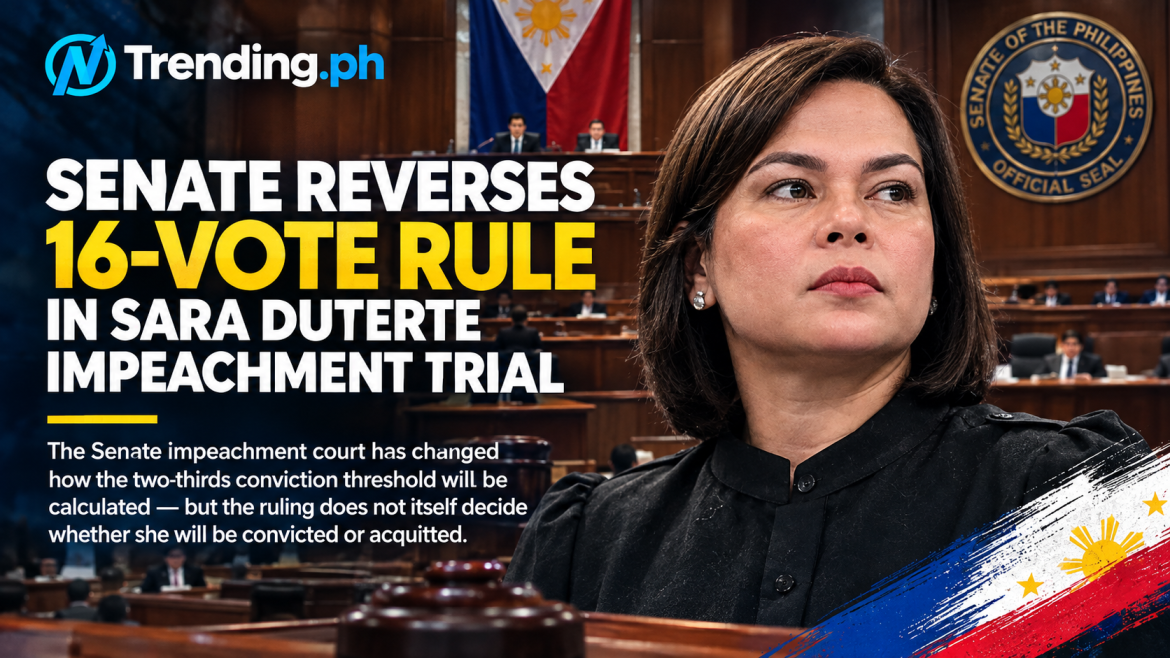
The Senate impeachment court has changed how the two-thirds conviction threshold will be calculated in Vice President Sara Duterte’s impeachment trial, but the ruling does not itself decide whether she will be convicted or acquitted.
The Senate impeachment court on Wednesday, September 23, voted 13-1 to overturn Presiding Officer Francis “Chiz” Escudero’s July 6 ruling that 16 votes, or two-thirds of the full 24-member Senate, would be required to convict Vice President Sara Duterte.
The court instead adopted a formula that counts only senator-judges who are legally and factually capable of participating when the final judgment is made.
This does not establish a permanent 14-vote requirement.
Rather, the court will determine which senator-judges should be excluded from the denominator based on circumstances that prevent them from legally or factually participating in the trial. Escudero explained that the categories may include senators who are detained or otherwise legally restrained from performing their functions, whose whereabouts are unknown while being sought by authorities, who are physically or medically incapacitated, or who are beyond the Senate’s coercive processes.
What does that mean in numbers?
Under the original interpretation, the Constitution’s requirement of two-thirds of all Senate members meant 16 of 24 senators.
Under Wednesday’s ruling, the denominator can change depending on which senator-judges are legally and factually able to participate.
For example, if 20 senators are determined to be qualified to participate at the time of the final vote, two-thirds would be 13.33. The court said that figure would be rounded up, meaning 14 votes would be needed for conviction.
Four senator-judges have been unable to participate in the proceedings: Jinggoy Estrada and Rodante Marcoleta are detained in connection with separate plunder cases; Ronald “Bato” dela Rosa has been absent amid an International Criminal Court arrest warrant; and Loren Legarda has been abroad on medical leave.
However, the ruling does not automatically mean that these four, or any other senator, will simply be removed from the calculation. The court said exclusions must be determined on the basis of the circumstances and sufficient evidence.
Who voted?
Thirteen senator-judges voted to overturn Escudero’s July 6 ruling, while Escudero himself cast the lone “no” vote.
Those who voted in favor were Bam Aquino, JV Ejercito, Sherwin Gatchalian, Risa Hontiveros, Panfilo Lacson, Lito Lapid, Francis Pangilinan, Vicente “Tito” Sotto III, Erwin Tulfo, Raffy Tulfo, Joel Villanueva, Mark Villar and Juan Miguel Zubiri.
Six senator-judges did not participate in the vote: Alan Peter Cayetano, Pia Cayetano, Christopher “Bong” Go, Imee Marcos, Robin Padilla and Camille Villar.
The vote came after the court rejected Cayetano’s attempt to defer the issue and have the Supreme Court resolve the constitutional question instead.
Why was the 16-vote rule challenged?
The dispute centers on the wording of Article XI, Section 3(6) of the 1987 Constitution, which states that an impeached official cannot be convicted without the concurrence of two-thirds of all the Members of the Senate.
Escudero’s July 6 interpretation treated the 24-member Senate as the fixed denominator.
Senator-Judge Erwin Tulfo later challenged that interpretation, arguing that senators who are unable to participate should not necessarily be included in determining the number of votes required for conviction.
The impeachment court sought opinions from retired Supreme Court justices and other legal experts acting as amici curiae, or friends of the court, before hearing arguments from both the prosecution and defense. The legal experts did not all take the same position on how the constitutional phrase should be interpreted.
The defense argued that Escudero’s July 6 ruling should stand and that there had been no intervening event that justified reopening the issue.
The House prosecution, meanwhile, said its responsibility remains the same regardless of the threshold: present evidence and prove the four Articles of Impeachment. Lead prosecutor Chel Diokno said the prosecution would continue doing its job regardless of how many votes are ultimately required.
Panelo says the issue could reach the Supreme Court
Former Executive Secretary and presidential legal counsel Salvador Panelo has strongly questioned the Senate impeachment court’s authority to change the basis for calculating the threshold.
Panelo previously argued that senator-judges could debate and seek legal opinions on the issue, but should not vote to change what he considers a constitutionally prescribed standard. He warned that such a move could be challenged before the Supreme Court through a petition alleging grave abuse of discretion amounting to lack or excess of jurisdiction.
Following Wednesday’s ruling, the question of whether the issue can now be taken to the Supreme Court remains contested.
The House prosecution has said it considers the matter not yet ripe for Supreme Court review while the impeachment trial is ongoing. House lead prosecutor Gerville Luistro, citing prosecutor Chel Diokno, said the issue would become justiciable after the Senate votes on the actual verdict, although parties could potentially seek judicial remedies if they believe grave abuse of discretion occurred.
Duterte’s defense team, for its part, has said it will consider exhausting legal remedies following the ruling.
Panelo also backs Duterte’s defense
Panelo has separately commented on the performance of Duterte’s defense team, arguing that the defense has the stronger position in the impeachment case and criticizing what he characterized as weaknesses in the prosecution’s presentation.
Those comments are Panelo’s assessment, not a finding of the impeachment court. The prosecution continues to present its evidence, while Duterte’s defense has the opportunity to challenge that evidence and present its own arguments.
The distinction matters because the Senate has not yet ruled on the substance of the impeachment charges.
What happens next?
Wednesday’s vote was not the verdict on Vice President Sara Duterte.
The impeachment trial will continue, with the prosecution presenting its evidence and the defense responding to the allegations. At the conclusion of the proceedings, the senator-judges will vote on whether Duterte should be convicted or acquitted.
It is at that stage that the new formula adopted Wednesday will be applied.
If the court determines that 20 senator-judges are legally and factually capable of participating, 14 votes would be required for conviction. But if the number of qualified participants changes, the required two-thirds number could change as well.
The Senate has therefore changed the math of the eventual vote, but not the verdict itself.
And that leaves a bigger question for the country:
Will the controversy over the voting threshold become as important as the evidence presented in the impeachment trial itself?
As the proceedings continue, the public will have to watch not only how many senators may ultimately vote, but also what evidence the prosecution and defense put before them.
The trial is still ongoing. The final judgment has yet to be made.